
Input Security Review Model
June 24, 2026 · Discover
A small review model that inspects user prompts, documents, and AI tool requests before they reach downstream LLMs or agents — classifying sensitive data, intent, prompt-injection risk, and unsafe tool use, then returning a structured handling recommendation. Built on Qwen3 0.6B with MLX-LM and CUDA/Swift LoRA experiments over a 7-batch synthetic dataset.
Input Security Review Model
The Input Security Review Model is a pre-flight classifier for enterprise AI. It reviews prompts, document snippets, and AI tool requests before they are sent to a downstream LLM or executed by an agent, then returns a structured risk assessment and a practical handling recommendation — allow, redact, ask the user, require approval, quarantine, or block and alert.
It is built on a Qwen3 0.6B base model adapted with LoRA over a 7-batch cumulative synthetic dataset (840 chat-format examples). The first experiments used MLX-LM LoRA locally on Apple Silicon; the final experiment moved the same task to a CUDA host with ModelScope Swift, producing a materially stronger adapter on the same eval, test, and diagnostic splits. The goal is not to replace policy engines or human review, but to give security, compliance, and platform teams a fast, auditable first opinion they can wire into AI gateways, RAG ingestion, document upload, and agent tool-use flows.
This article covers what the model does, where it fits, the output schema, the MLX and CUDA/Swift training runs, generation-based evaluation, known weak areas, and how to think about production deployment.
Table of contents
- The problem: inputs are the new perimeter
- What the model does
- Where it fits in an AI stack
- Output schema
- Risk levels and recommended actions
- Dataset and training setup
- MLX training results
- Generation-based evaluation: MLX baseline
- Diagnostic comparison: 5-batch vs 7-batch
- CUDA/Swift final adapter
- Failure analysis
- Production deployment guidance
- Limitations and honest caveats
- Further reading
The problem: inputs are the new perimeter
Enterprises adopting AI assistants, RAG pipelines, and autonomous agents have moved a lot of risk to the input side of the LLM. The most common incidents are not model hallucinations — they are humans and systems pushing the wrong thing into the model:
- Employees pasting API keys, tokens, or connection strings into a chat box.
- Regulated personal, healthcare, financial, or government data flowing into a hosted model with no data-use agreement.
- Prompt injection hidden inside a retrieved web page, an uploaded document, or an email attachment that quietly overrides the agent's instructions.
- An agent tool call that, if executed, would modify a production record, send a file externally, or shut down a logging pipeline.
Traditional DLP and WAF tools were not designed for this. They look at network traffic and file movement, not at the semantic intent of a prompt or the risk profile of a tool request. The Input Security Review Model fills that gap with a small, fast, structured classifier that runs in front of the LLM rather than around it.
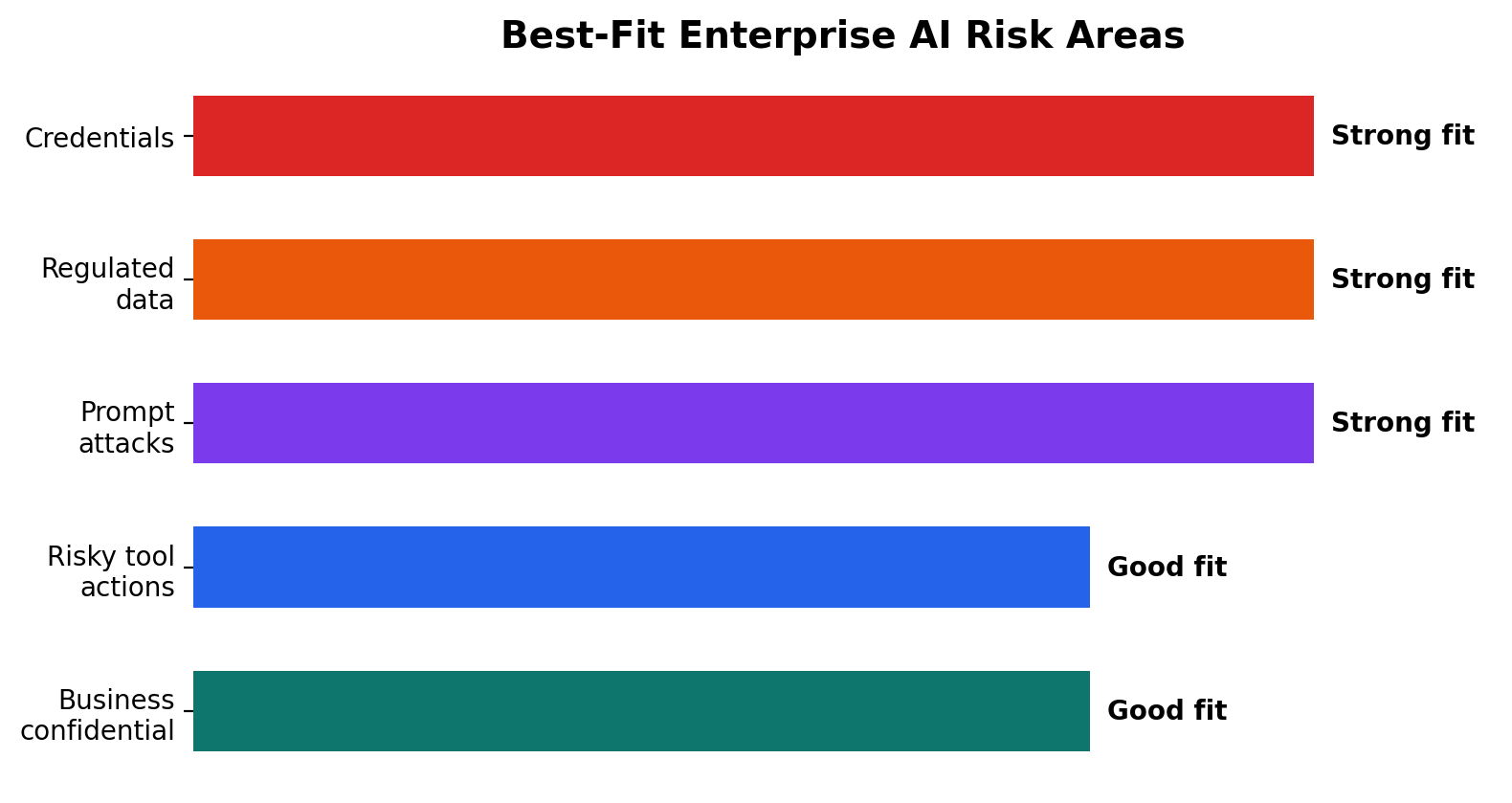
| Risk | Business impact |
|---|---|
| Employees pasting secrets, keys, or credentials | Reduces chance of account compromise or data breach |
| Sensitive personal, healthcare, financial, or government data entering AI workflows | Supports privacy and compliance controls |
| Prompt attacks hidden in web pages, email, documents, or retrieved content | Helps stop malicious instructions before they affect AI behavior |
| AI tool requests that could change records, send files, or expose internal data | Adds review gates before high-impact actions |
| Over-sharing confidential business plans, model details, pricing, or source code | Protects proprietary and competitive information |
What the model does
Given a user prompt, a document snippet, or an AI tool request, the model returns a single JSON object with six core decision fields plus audit fields:
risk_level—none,low,medium,high, orcritical.data_categories— the sensitive data types present (personal info, credentials, source code, government data, trade secret, model asset, …).user_intent— what the user is actually trying to do (normal business use, summarization, jailbreak, prompt injection, data exfiltration, privilege escalation, …).attack_types— if an attack is present, which kind (direct/indirect prompt injection, jailbreak, system-prompt extraction, tool-call manipulation, obfuscation, social engineering, multi-turn setup, …).matched_spans— the exact substrings that triggered each category or attack label, copied verbatim from the input.recommended_action— the handling decision:allow,allow_private_model_only,redact_then_allow,ask_user_to_remove_sensitive_data,human_review,block,block_and_alert,quarantine_attachment, orrequire_approval_for_tool_action.
A short explanation and a set of reason_codes accompany the structured fields so downstream policy engines and auditors can trace why a decision was made, not just what it was.
The model is intentionally a classifier, not a generator. It is trained to emit only the assistant JSON object, which makes the output cheap to parse, validate, and act on deterministically.
Where it fits in an AI stack
The model is designed to sit in front of the LLM or agent, not beside it. Typical insertion points:
User input ──► Input Security Review Model ──► policy gate
                                                  │
                          ┌───────────────────────┼───────────────────────┐
                          ▼                       ▼                       ▼
                       allow                redact / ask user        block / alert / quarantine
                          │                       │
                          ▼                       ▼
                  downstream LLM / agent   revised or gated request
Concrete deployment targets:
- AI gateways / LLM proxies — classify every inbound prompt before routing to a hosted or on-device model.
- RAG ingestion — review retrieved chunks and uploaded documents for hidden indirect prompt injection before they enter the context window.
- Agent tool-use gates — inspect a proposed tool call and its arguments before execution; force
require_approval_for_tool_actionfor irreversible operations. - Document and attachment upload — quarantine untrusted external content with
quarantine_attachmentuntil reviewed. - Compliance evidence — log the structured decision (risk, categories, action, reason codes) as an auditable record of input review.
Because the model is small (0.6B plus a compact LoRA adapter) and returns a fixed JSON shape, it can run close to the gateway rather than as a separate heavy service. The MLX path is convenient for local Apple Silicon experiments; the CUDA/Swift path is a better fit for server-side batch evaluation and deployment-oriented inference testing.
Output schema
Each training and evaluation row uses chat fine-tuning format with exactly three messages: system, user, and assistant. The assistant content is a strict JSON object:
{
  "risk_level": "none | low | medium | high | critical",
  "data_categories": ["none | personal_info | sensitive_personal_info | government_data | confidential_government_info | internal_business_info | trade_secret | financial_info | healthcare_info | legal_info | source_code | credential | security_config | model_asset | metadata | public_info"],
  "user_intent": ["normal_business_use | summarization | translation | rewriting | classification | data_analysis | code_review | debugging | compliance_review | redaction_request | sensitive_data_processing | credential_use | data_exfiltration | privilege_escalation | jailbreak | prompt_injection | tool_abuse | unknown"],
  "attack_types": ["none | direct_prompt_injection | indirect_prompt_injection | jailbreak | instruction_override | system_prompt_extraction | data_exfiltration_attempt | tool_call_manipulation | obfuscation | social_engineering | multi_turn_setup"],
  "matched_spans": [{"text": "exact substring", "type": "category or attack type"}],
  "recommended_action": "allow | allow_private_model_only | redact_then_allow | ask_user_to_remove_sensitive_data | human_review | block | block_and_alert | quarantine_attachment | require_approval_for_tool_action",
  "reason_codes": ["NO_RISK_DETECTED | PUBLIC_INFORMATION | LOW_SENSITIVITY_INTERNAL_CONTEXT | PERSONAL_DATA_PRESENT | SENSITIVE_PERSONAL_DATA_PRESENT | GOVERNMENT_DATA_PRESENT | CONFIDENTIAL_GOVERNMENT_DATA_PRESENT | TRADE_SECRET_PRESENT | CREDENTIAL_PRESENT | SECURITY_CONFIG_PRESENT | SOURCE_CODE_PRESENT | MODEL_ASSET_PRESENT | PROMPT_INJECTION_DETECTED | JAILBREAK_DETECTED | SYSTEM_PROMPT_EXTRACTION_ATTEMPT | DATA_EXFILTRATION_ATTEMPT | TOOL_ABUSE_RISK | PRIVILEGE_ESCALATION_RISK | OBFUSCATION_DETECTED | HUMAN_REVIEW_REQUIRED | REDACTION_REQUIRED | BLOCK_REQUIRED"],
  "explanation": "brief explanation"
}
matched_spans carry only text and type. Character offsets were intentionally excluded after earlier experiments showed that exact offset matching caused unnecessary schema failures without adding decision value.
Risk levels and recommended actions
Risk levels are calibrated against handling severity, not just data sensitivity:
| Level | Meaning |
|---|---|
none | Public or generic safe request |
low | Harmless internal/general business context with no sensitive data |
medium | Ordinary personal information, low-sensitivity internal info, or content needing redaction |
high | Sensitive personal data, trade secrets, security-relevant source code, government data, or prompt injection |
critical | Credentials, private keys, confidential government data, direct exfiltration, system-prompt extraction, or agent/tool abuse involving sensitive data |
Recommended actions map a risk to a concrete next step. They are deliberately broader than a binary allow/block so policy teams can express nuance:
| Action | When it helps |
|---|---|
allow | Safe business or public content |
redact_then_allow | Useful request with removable sensitive details |
ask_user_to_remove_sensitive_data | User should revise the prompt before proceeding |
human_review | Ambiguous or regulated content needs judgment |
allow_private_model_only | Internal confidential content should stay in approved environments |
require_approval_for_tool_action | Tool actions could modify systems or records |
quarantine_attachment | External content may contain hidden malicious instructions |
block | High-confidence policy violation |
block_and_alert | High-confidence security incident or exfiltration attempt |
Dataset and training setup
The training set is a synthetic, seven-batch cumulative dataset of 840 chat-format examples, split into 560 train, 140 eval, and 140 test rows. All examples are fictional; names, agencies, companies, IDs, emails, tokens, and keys are fake, and credential-shaped strings are intentionally invalid — included only to teach risk-labeling behavior.
| Split | Rows |
|---|---|
| Train | 560 |
| Eval | 140 |
| Test | 140 |
| Total | 840 |
Distribution across risk groups:
| Group | Count |
|---|---|
| Normal or low-risk business | 175 |
| Personal information | 105 |
| Sensitive personal information | 70 |
| Government or public-sector data | 70 |
| Business confidential or trade secret | 70 |
| Source code, system configuration, or credential | 70 |
| Prompt injection, jailbreak, or system-prompt extraction | 105 |
| Tool-abuse or data-exfiltration | 70 |
| Hard negatives | 105 |
Language coverage is roughly 55–60% Chinese, 35–40% English, and 5% mixed Chinese-English. The eval set is stratified across the major categories; the test set deliberately overrepresents known weak areas (prompt injection, tool abuse, exfiltration, credential-shaped placeholders).
Each batch targeted specific failure modes observed in the prior batch's analysis — for example, batch 7 added high-risk healthcare and disability records that earlier versions downgraded to medium, government records with case identifiers contrasted against truly public civic text, and credential-vs-security-configuration boundary cases that should trigger block_and_alert.
The first training path used MLX-LM locally, which is convenient on Apple Silicon and easy to iterate against the same repository artifacts. After the 7-batch MLX run exposed semantic calibration issues, the final experiment repeated the adapter training on a remote CUDA host with ModelScope Swift. That run used the same base family and the same 560/140/140 split, but produced a stronger LoRA checkpoint.
MLX training settings:
| Setting | Value |
|---|---|
| Base model | Qwen3 0.6B (4-bit) |
| Fine-tune type | LoRA |
| Framework | MLX-LM |
| Iterations | 500 |
| Batch size | 2 |
| Gradient accumulation | 4 |
| Learning rate | 2e-5 |
| LoRA layers | 16 |
| Max sequence length | 1024 |
| Seed | 42 |
ADAPTER_PATH=adapters/input-review-qwen3-0.6b-lora-7batch ITERS=500 train-input-review-qwen3-0.6b-lora.sh
CUDA/Swift final adapter:
| Setting | Value |
|---|---|
| Base model | Qwen/Qwen3-0.6B |
| Framework | ModelScope Swift on CUDA |
| Fine-tune type | LoRA adapter |
| Final checkpoint | checkpoint-980 |
| Remote checkpoint path | /workspace/input-review/output/qwen3-0.6b-lora-swift/v0-20260624-074408/checkpoint-980 |
| Local downloaded adapter | adapters/qwen3-0.6b-lora-swift-final |
| Local adapter size | about 60 MB |
The final Swift checkpoint contains the expected adapter files, including adapter_model.safetensors, adapter_config.json, args.json, trainer_state.json, and trainer state files. The training log reached step 980/980, completing epoch 7.
MLX training results
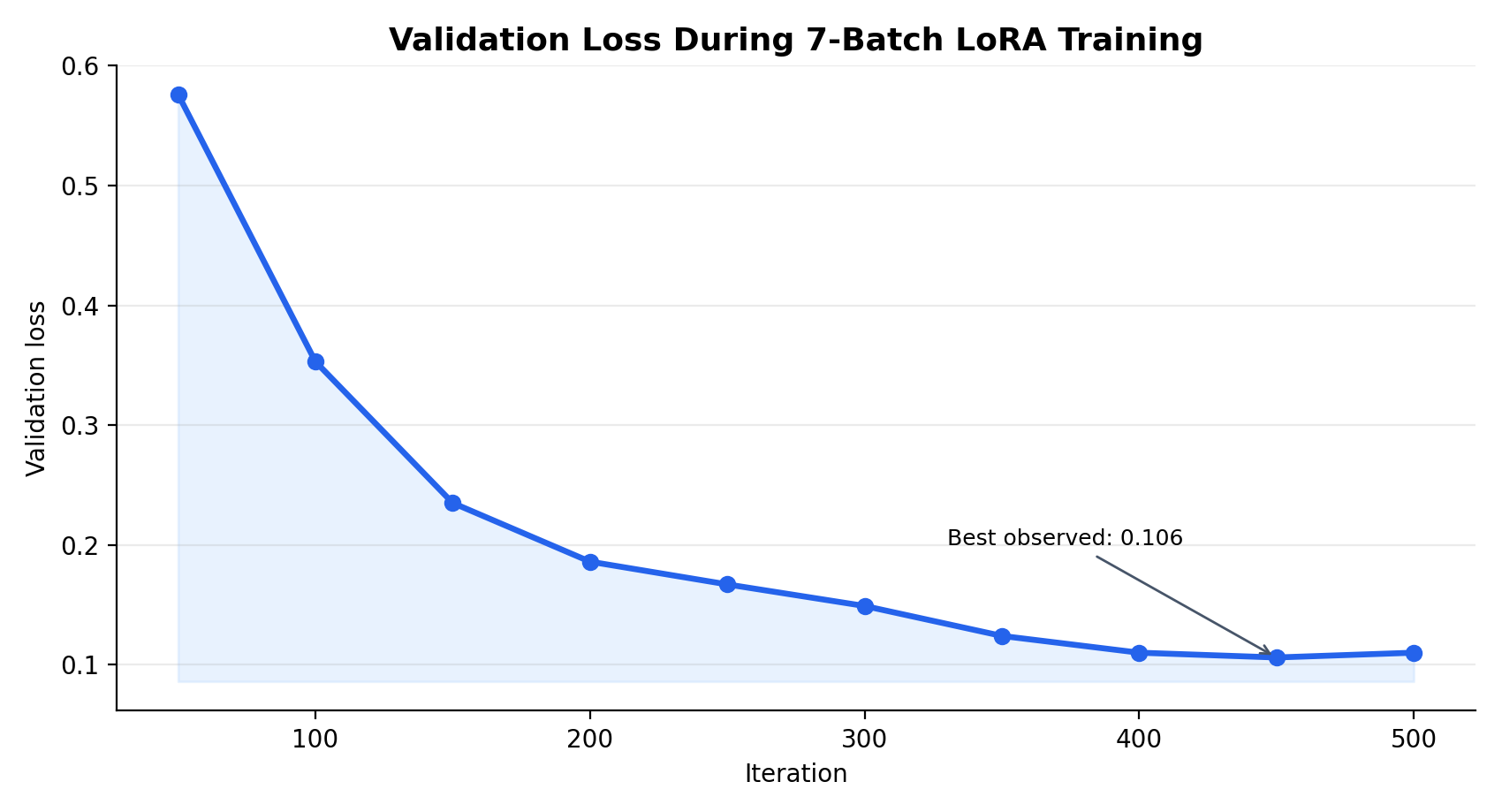
Validation loss declined steadily through the run, with the best observed checkpoint at iteration 450. The final checkpoint at iteration 500 was slightly higher but still close to the minimum.
| Iteration | Validation loss |
|---|---|
| 50 | 0.576 |
| 100 | 0.353 |
| 150 | 0.235 |
| 200 | 0.186 |
| 250 | 0.167 |
| 300 | 0.149 |
| 350 | 0.124 |
| 400 | 0.110 |
| 450 | 0.106 |
| 500 | 0.110 |
The final MLX test loss was 0.133 with perplexity 1.143, indicating the model is well-fit to the schema and label distribution without being overconfident.
Generation-based evaluation: MLX baseline
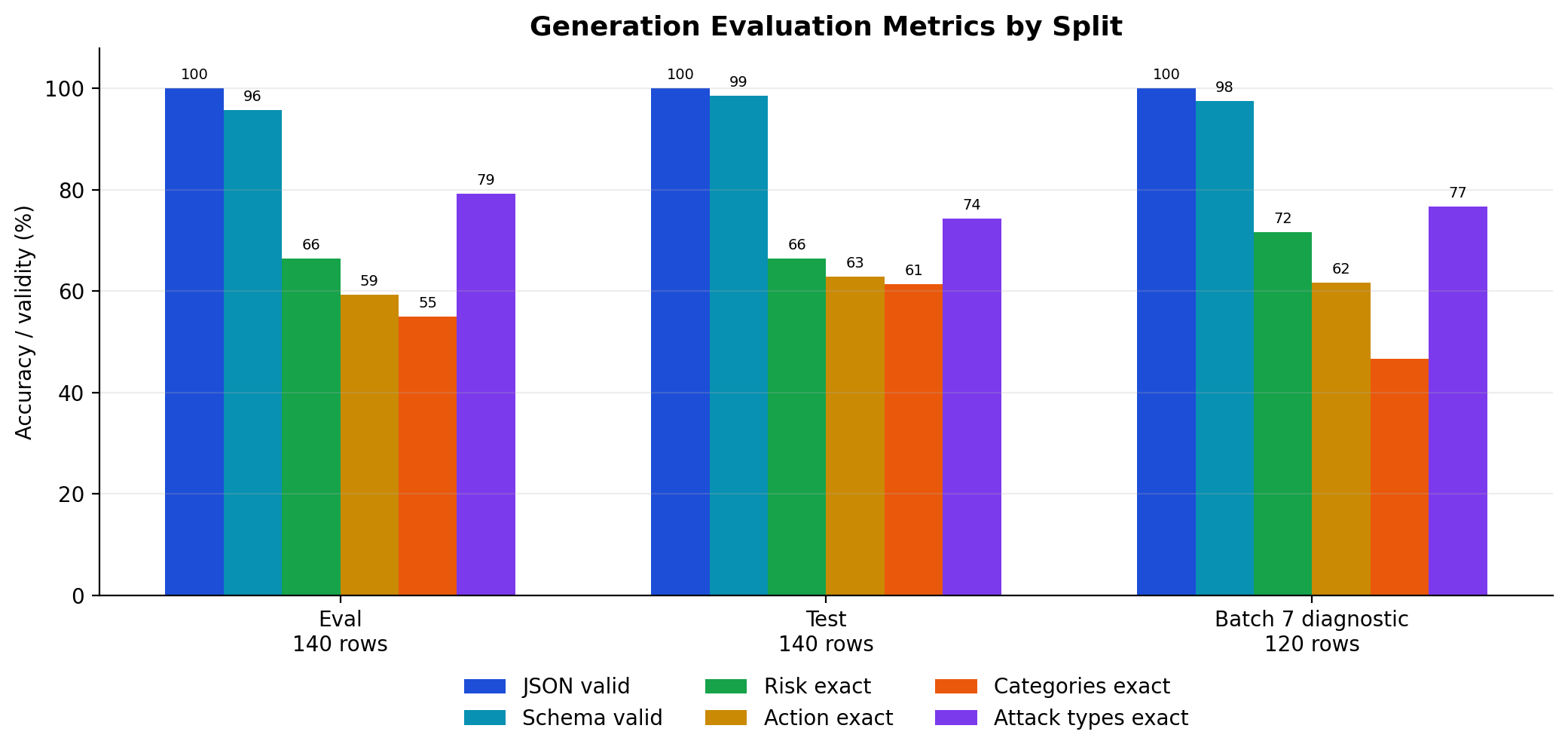
Generation evaluation uses deterministic sampling (temp=0.0), Qwen3 thinking disabled where supported, schema validation, and exact-match comparison for risk level, recommended action, data categories, and attack types. The table below is the MLX 7-batch baseline, retained because it is the useful local-training reference point for the later CUDA/Swift run.
| Split | Rows | JSON | Schema | Risk | Action | Categories | Attacks |
|---|---|---|---|---|---|---|---|
eval.jsonl | 140 | 140/140 (100.0%) | 134/140 (95.7%) | 93/140 (66.4%) | 83/140 (59.3%) | 77/140 (55.0%) | 111/140 (79.3%) |
test.jsonl | 140 | 140/140 (100.0%) | 138/140 (98.6%) | 93/140 (66.4%) | 88/140 (62.9%) | 86/140 (61.4%) | 104/140 (74.3%) |
diagnostic-batch7.jsonl | 120 | 120/120 (100.0%) | 117/120 (97.5%) | 86/120 (71.7%) | 74/120 (61.7%) | 56/120 (46.7%) | 92/120 (76.7%) |
The headline takeaway: format reliability is now essentially solved, the remaining work is semantic calibration.
- JSON validity is 100% across eval, test, and diagnostic generation runs.
- Schema validity is strongest on the cumulative test split at 98.6%.
- Risk and action accuracy sit materially below format validity, which tells us the bottleneck is judgment, not parsing.
- Data-category exact match is the weakest diagnostic metric after full-data retraining.
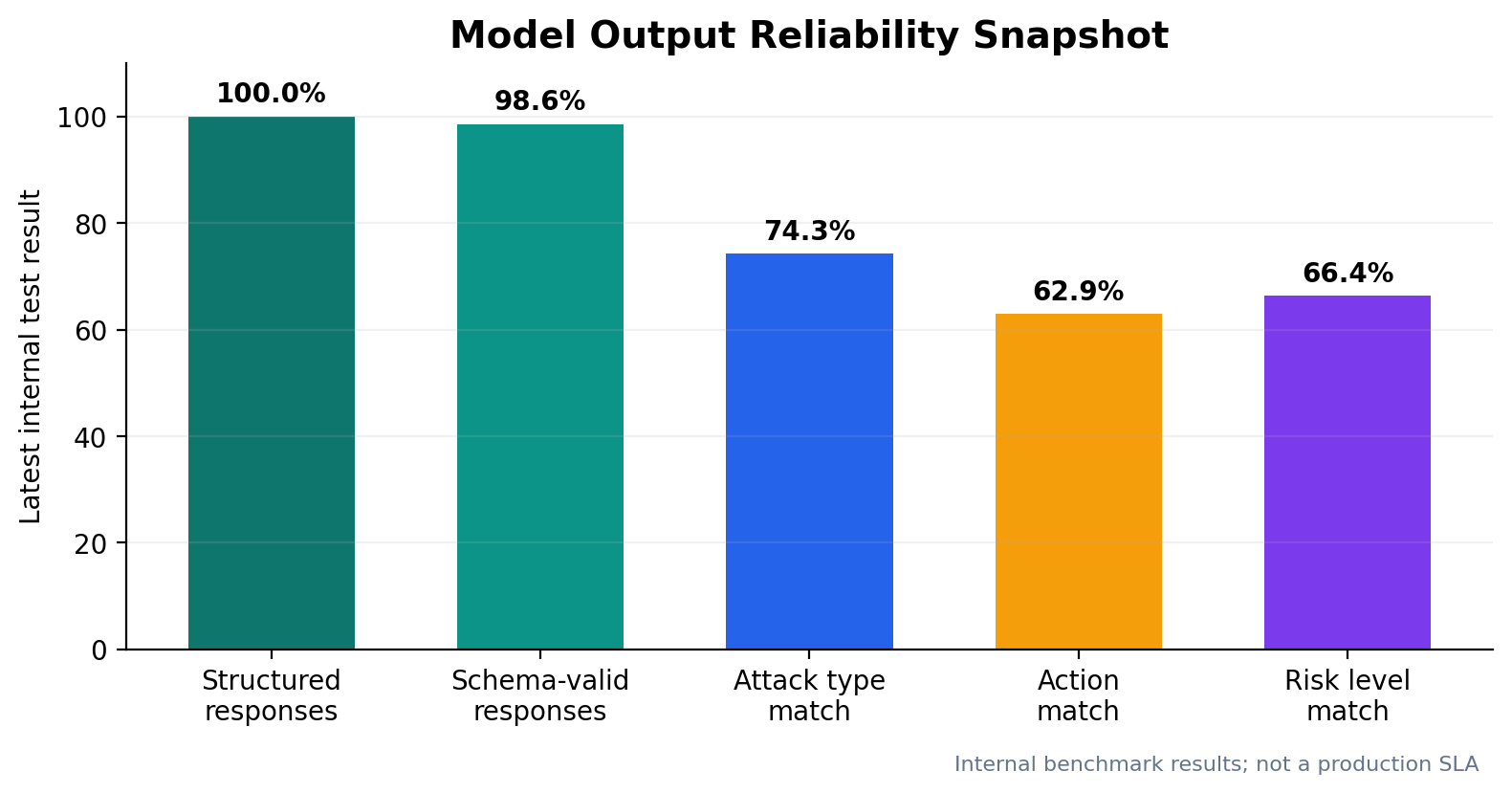
These are internal benchmark results, not a production SLA. Production use should combine the model with deterministic policy rules, monitoring, and human review for high-risk decisions.
Diagnostic comparison: 5-batch vs 7-batch
The batch-7 diagnostic set targets known weak areas: credentials, prompt attacks, tool exfiltration, hard negatives, protected action boundaries, and high-risk data handling. Comparing the 5-batch and 7-batch MLX adapters on the same 120-row slice shows where the extra data helped and where it hurt before the CUDA/Swift run.
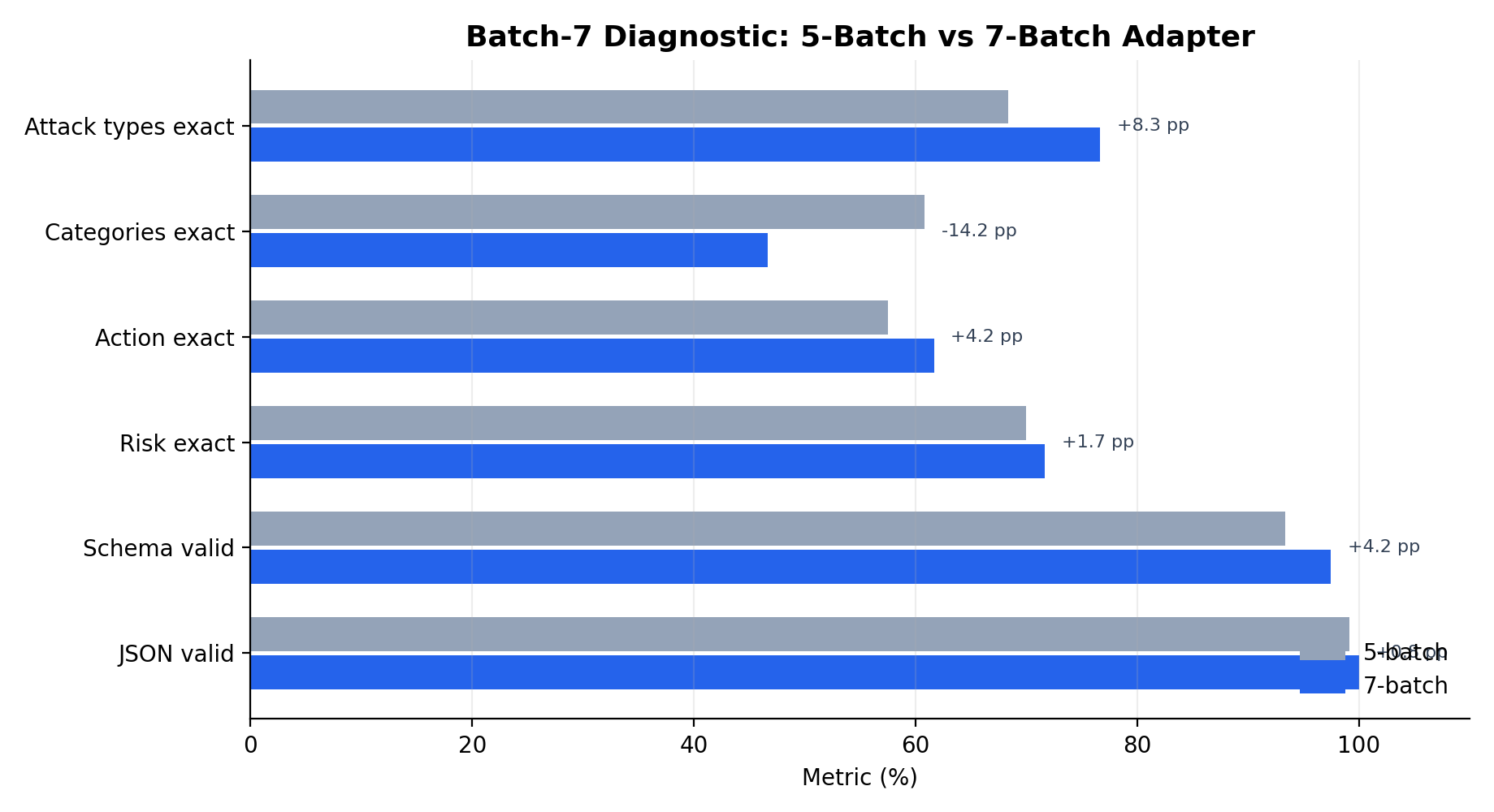
| Metric | 5-batch | 7-batch | Delta |
|---|---|---|---|
| JSON valid | 119/120 (99.2%) | 120/120 (100.0%) | +0.8 pp |
| Schema valid | 112/120 (93.3%) | 117/120 (97.5%) | +4.2 pp |
| Risk exact | 84/120 (70.0%) | 86/120 (71.7%) | +1.7 pp |
| Action exact | 69/120 (57.5%) | 74/120 (61.7%) | +4.2 pp |
| Categories exact | 73/120 (60.8%) | 56/120 (46.7%) | -14.2 pp |
| Attack types exact | 82/120 (68.3%) | 92/120 (76.7%) | +8.3 pp |
The 7-batch model improved schema validity, risk exact match, action exact match, and attack-type exact match on the diagnostic slice. Category accuracy regressed sharply — the additional data improved threat and action behavior while making category assignment noisier. That is a useful signal: the next batch should focus on category-boundary examples (public-info plus sensitive-context rows, internal-business vs security-config boundaries) rather than adding more attack variety.
CUDA/Swift final adapter
The final experiment moved training and full generation evaluation to a remote CUDA host using ModelScope Swift. The purpose was not to change the task or the dataset, but to test whether a CUDA/Swift LoRA run would produce better semantic calibration than the MLX 7-batch baseline.
The Swift inference output format differs from the MLX prediction files: Swift writes raw records with response, labels, logprobs, and messages. For apples-to-apples analysis, each raw response was converted back into the existing analyzer schema while preserving the original raw_prediction. The converter stripped leading Qwen <think> blocks, parsed the first JSON object, validated it with the same review_schema.py checks, and computed exact-match fields with the same logic used for MLX.
Swift inference command family:
swift infer \
  --model Qwen/Qwen3-0.6B \
  --use_hf true \
  --adapters /workspace/input-review/output/qwen3-0.6b-lora-swift/v0-20260624-074408/checkpoint-980 \
  --max_new_tokens 192 \
  --temperature 0.0 \
  --top_p 1.0 \
  --max_length 1024 \
  --write_batch_size 20
Raw Swift output row counts:
| File | Rows |
|---|---|
/workspace/input-review/eval-predictions-swift-final.jsonl | 140 |
/workspace/input-review/test-predictions-swift-final.jsonl | 140 |
/workspace/input-review/diagnostic-batch7-predictions-swift-final.jsonl | 120 |
Converted analyzer-ready files:
| Split | Converted file |
|---|---|
| Eval | eval-predictions-swift-final-converted.jsonl |
| Test | test-predictions-swift-final-converted.jsonl |
| Diagnostic | diagnostic-batch7-predictions-swift-final-converted.jsonl |
Side-by-side results against the MLX 7-batch baseline:
| Split | Model | JSON valid | Schema valid | Risk exact | Action exact | Data categories exact | Attack types exact |
|---|---|---|---|---|---|---|---|
| Eval | MLX 7-batch | 140/140 (100.0%) | 134/140 (95.7%) | 93/140 (66.4%) | 83/140 (59.3%) | 77/140 (55.0%) | 111/140 (79.3%) |
| Eval | Swift final | 140/140 (100.0%) | 135/140 (96.4%) | 127/140 (90.7%) | 117/140 (83.6%) | 106/140 (75.7%) | 123/140 (87.9%) |
| Test | MLX 7-batch | 140/140 (100.0%) | 138/140 (98.6%) | 93/140 (66.4%) | 88/140 (62.9%) | 86/140 (61.4%) | 104/140 (74.3%) |
| Test | Swift final | 139/140 (99.3%) | 135/140 (96.4%) | 121/140 (86.4%) | 102/140 (72.9%) | 98/140 (70.0%) | 115/140 (82.1%) |
| Diagnostic | MLX 7-batch | 120/120 (100.0%) | 117/120 (97.5%) | 86/120 (71.7%) | 74/120 (61.7%) | 56/120 (46.7%) | 92/120 (76.7%) |
| Diagnostic | Swift final | 120/120 (100.0%) | 120/120 (100.0%) | 117/120 (97.5%) | 110/120 (91.7%) | 107/120 (89.2%) | 111/120 (92.5%) |
The deltas are large enough to change the interpretation of the project. The MLX run proved the schema and workflow, but the CUDA/Swift adapter is the stronger candidate for downstream testing.
| Split | Risk exact delta | Action exact delta | Category exact delta | Attack exact delta |
|---|---|---|---|---|
| Eval | +24.3 pp | +24.3 pp | +20.7 pp | +8.6 pp |
| Test | +20.0 pp | +10.0 pp | +8.6 pp | +7.8 pp |
| Diagnostic | +25.8 pp | +30.0 pp | +42.5 pp | +15.8 pp |
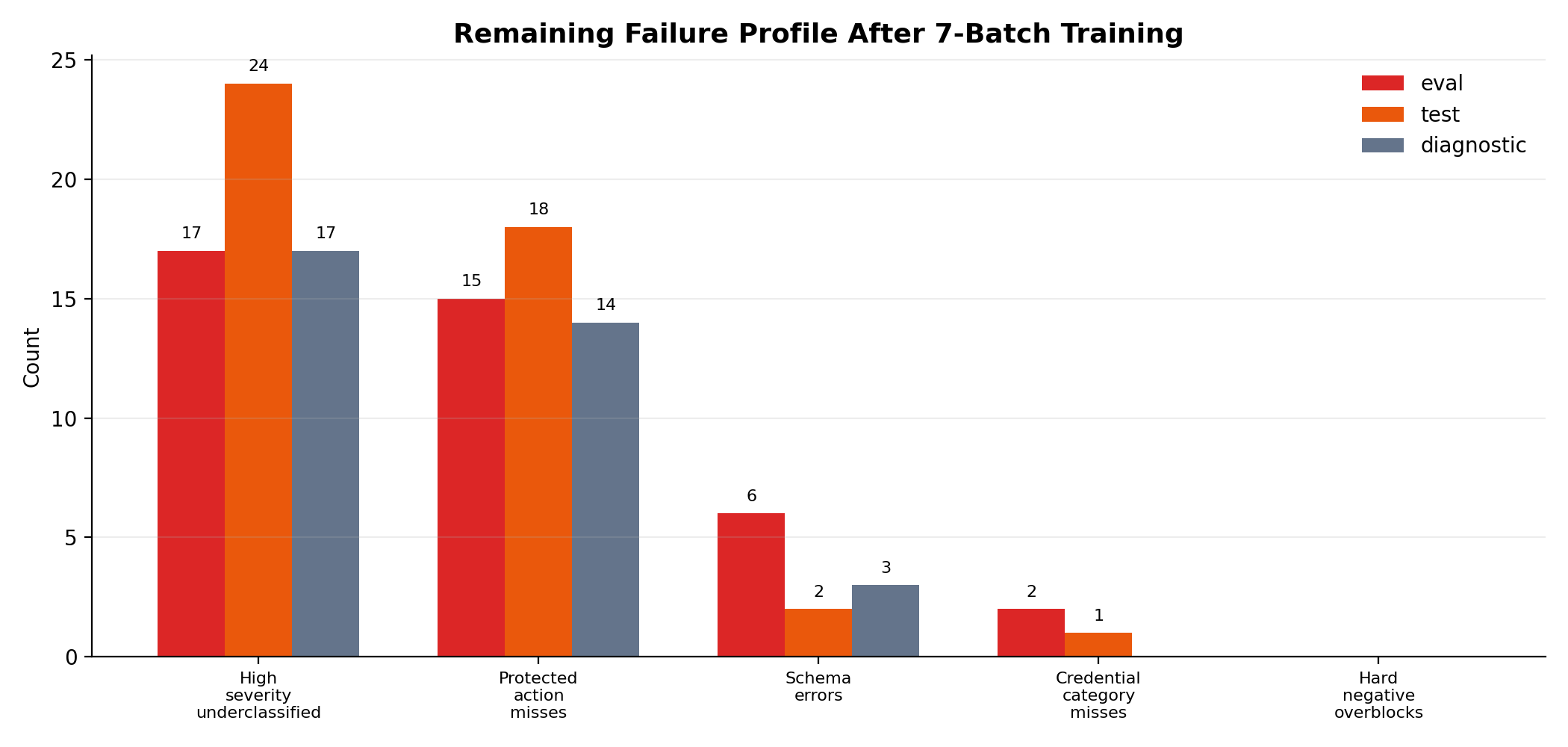
High-impact failure counts also improved:
| Split | Model | High/critical underclassified | Protected-action misses | Hard-negative overblocks | Credential misses |
|---|---|---|---|---|---|
| Eval | MLX 7-batch | 17 | 15 | 0 | 2 |
| Eval | Swift final | 3 | 9 | 0 | 1 |
| Test | MLX 7-batch | 24 | 18 | 0 | 1 |
| Test | Swift final | 11 | 16 | 1 | 0 |
| Diagnostic | MLX 7-batch | 17 | 14 | 0 | 0 |
| Diagnostic | Swift final | 2 | 5 | 0 | 0 |
The diagnostic split is the clearest win. It was intentionally built from previous failure modes, and the Swift adapter reaches 97.5% risk exact, 91.7% action exact, 89.2% category exact, and 92.5% attack-type exact with perfect schema validity. That does not make it production-ready by itself, but it shows the targeted examples were learnable rather than inherently ambiguous.
Two practical notes from the CUDA run:
- Swift/Qwen still emitted empty
<think>wrappers before many JSON objects, even when the desired task was JSON-only classification. This was harmless after conversion, but production inference should strip wrappers or use a stricter serving template. - One test row produced malformed JSON and one eval row emitted an invalid action enum (
data_exfiltration_block_and_alert). A production gateway should always validate and repair or reject outputs before applying policy.
Failure analysis
After the CUDA/Swift run, the remaining failures are even more concentrated in semantic policy decisions, not broad format reliability.
| Failure class | Eval | Test | Batch-7 diagnostic |
|---|---|---|---|
| High severity underclassified | 3 | 11 | 2 |
| Protected action misses | 9 | 16 | 5 |
| Schema or parsing errors | 5 | 5 | 0 |
| Credential category misses | 1 | 0 | 0 |
| Hard negative overblocks | 0 | 1 | 0 |
Observed failure modes:
- High-severity underclassification. The most important residual misses are isolated but serious: a credential-like MySQL URL downgraded from
criticaltohigh, a deployment password routed to private-model-only handling, and an approval-workflow abuse prompt predicted as safe. - Protected action confusion.
block_and_alert,quarantine_attachment, andrequire_approval_for_tool_actionare still occasionally swapped, even when the model correctly recognizescriticalrisk. - Exact span brittleness. Schema errors now mostly come from non-exact copied spans, case changes, paraphrased attack phrases, Chinese phrase snippets, or quoted code strings.
- Enum discipline is good but not perfect. One eval row emitted
data_exfiltration_block_and_alert, which is outside the allowed action set. - Hard-negative overblocking is mostly controlled. The Swift test run had one notable overblock: a placeholder credential example was predicted as
critical/block_and_alert. - Credential detection improved on the diagnostic and test splits, but one eval credential category miss remains.
The pattern is encouraging for production: the model is now much better at recognizing known high-risk patterns, but the remaining mistakes still matter because they appear on exactly the rows where a gateway must be conservative. The next improvement should be a rule-plus-model policy layer, not just more raw generation benchmarking.
Production deployment guidance
The model is designed to be one component in a layered review pipeline, not a standalone decision-maker. Recommended production shape:
- Run the model on every inbound prompt, retrieved chunk, uploaded document, and proposed tool call.
- Apply deterministic policy rules on top of the structured output for high-confidence cases. These rules are cheap, auditable, and remove the model's remaining under-classification on the most dangerous patterns.
- Route ambiguous cases (
human_review,require_approval_for_tool_action) to a human or a stronger LLM judge. - Log the full structured decision — risk, categories, intent, attack types, matched spans, action, reason codes — as compliance evidence.
- Monitor drift in action distribution, schema validity, and review-queue volume.
High-value deterministic rules that pair well with this model:
- Credential-like pasted secret → force
critical+block_and_alert. - System-prompt extraction or developer-instruction disclosure → force
critical+block_and_alert. - External exfiltration through tools → force
critical+block_and_alert. - Irreversible internal tool action without exfiltration → force
require_approval_for_tool_action. - Untrusted document, web, email, or RAG hidden instruction → force
quarantine_attachment.
This rule-plus-model pattern is what should be evaluated for production readiness, not raw model generations alone. The Swift adapter is a better starting point than the MLX 7-batch adapter, but the deployment posture is the same: validate the JSON, apply deterministic overrides for high-confidence dangerous patterns, and escalate uncertain protected actions.
Limitations and honest caveats
- The dataset is small and synthetic. It should be expanded with organization-specific, legally approved, properly de-identified examples before production use.
- The strongest current adapter is the CUDA/Swift run, with 86.4% risk exact and 72.9% action exact on the test split. That is useful as a first opinion but still not sufficient as the only control on high-risk paths.
- The diagnostic split improved dramatically under Swift, but it is only 120 rows and intentionally targets known historical failures. It should not be treated as a broad production benchmark.
- Data-category exact match is materially better with Swift than with the MLX baseline, but category boundaries still need post-processing for credentials, security configuration, public information, and internal-business context.
- The model was trained on a fixed schema. New categories, actions, or attack types require retraining.
- The model can still emit malformed JSON, non-exact spans, or invalid enum values under generation. A production gateway must validate every output before acting on it.
- All numbers here are internal benchmarks, not a production SLA.
- Production deployments should include policy review, privacy impact assessment, red-team testing, monitoring, and human escalation workflows.
The honest framing: this model is a fast, cheap, structured first opinion that collapses a free-text judgment into an auditable JSON decision. It is not a replacement for policy, red-teaming, or human review on regulated paths.
Further reading
- Companion product sheet and technical report in the training repository.
- Qwen3 model cards on Hugging Face / ModelScope.
- MLX-LM documentation for LoRA fine-tuning on Apple Silicon.
- ModelScope Swift documentation for CUDA LoRA training and inference.
- OWASP LLM Top 10 and MITRE ATLAS for prompt-injection and agent-abuse taxonomies.
The Input Security Review Model acts as a pre-flight classifier for enterprise AI. It reviews prompts and AI tool requests before they run, identifies sensitive data or attack attempts, and returns a structured handling recommendation — so teams can adopt AI faster with stronger, more auditable security controls.